
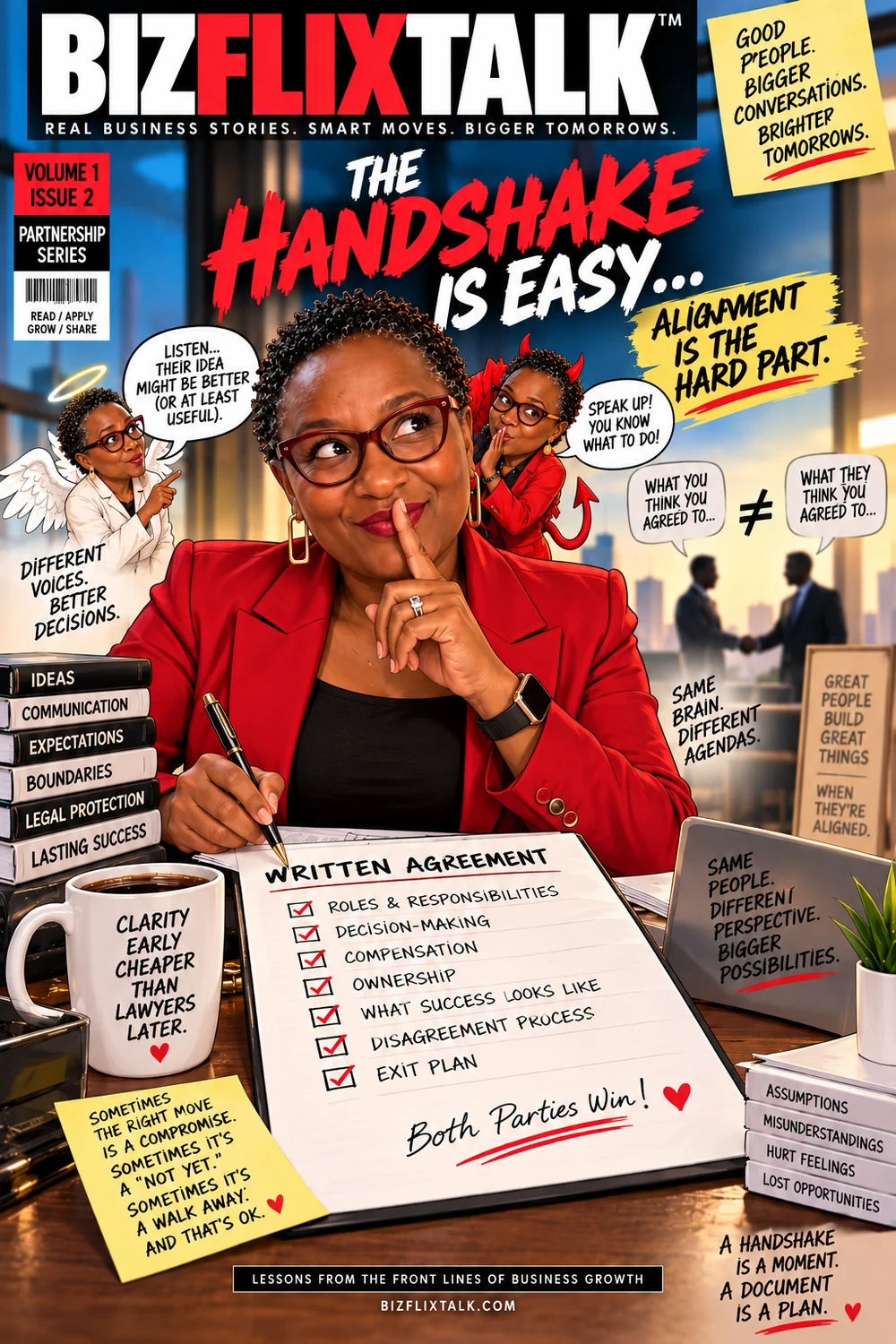
There is a scene in almost every business drama where two people shake hands, smile, and walk away from the table.
The audience already knows what the characters don’t: they just agreed to two completely different things.
It makes for good storytelling because it happens in real business all the time. Everybody leaves the meeting excited. Everybody believes they’re on the same page.
Then six months later somebody says: “Wait. That’s not what I thought we agreed to.”
And there goes the inspirational music.
Agreement is not alignment
Most partnership problems don’t start with betrayal. They start with assumptions nobody bothered to say out loud.
Sometimes we avoid those conversations because things are going well. Nobody wants to be the person who brings up conflict when there isn’t any. But that’s exactly when we should be talking.
- What does success look like to each of us?
- Who makes the final decision when we disagree?
- Who owns what?
- What happens if somebody wants out?
- How and when does everybody get paid?
- What is each person actually responsible for?
- What does each person believe they are getting from this relationship?
Because two people can be sitting at the same table, working on the same project, and still have very different agendas.
The conversation you avoid at the beginning can become the dispute you cannot avoid later.
Sometimes you have to put your hand over your mouth
This one is hard for me.
Sometimes I walk into a situation already knowing what I want to do. I have my agenda. I have my ideas. And I have a voice in my head saying, “This is what we need to do.” Actually, I have several voices in there, and sometimes they refuse to leave me alone.
But somebody else at that table has a voice too. And just maybe — I know, shocking — their idea might be important. It might even be better. Or it may reveal something I hadn’t considered.
The problem is that it’s hard to hear someone else’s voice when the one inside your own head is so loud. There have literally been times when I’ve had to put my hand over my mouth to remind myself:
Kat, be quiet and listen.
Listening doesn’t mean surrendering your position. It means making sure you understand the other person’s position before deciding what the agreement should be.
And sometimes, after everybody has been heard, you discover there really isn’t alignment. That’s important information too.
Not every deal needs to be won
Sometimes the other person should get the win. Sometimes you compromise. Sometimes you restructure the agreement until both parties can win. And sometimes you need to shake hands, wish each other well, and walk away.
Every opportunity doesn’t have to become a deal.
All business is not good business, and every partnership is not the right partnership.
Walking away from an agreement that doesn’t work for both sides isn’t necessarily failure. Sometimes that’s good business judgment.
The mistake is knowing something doesn’t feel right and saying nothing because you want to keep the peace. Putting your head in the sand doesn’t eliminate the disagreement. It just gives it time to grow.
Write it down while you still like each other
The best time to decide how you’ll handle disagreement is when you’re getting along. Not after somebody is angry. Not after money is involved. Not after somebody wants out. And definitely not after everybody has hired lawyers.
Because human beings are interesting creatures. Have you ever said something that seemed perfectly clear to you, only to have the other person repeat back something completely different?
Oh, I know, I know. You’re perfect. That’s never happened to you.
It happens to all of us. We hear conversations through our own experiences, expectations and assumptions. What I said, what I meant, what you heard, and what you thought I meant can become four completely different things.
Don’t build an important business relationship on everyone’s memory of the conversation. Get the important things in writing. And for significant partnerships, ownership arrangements, contracts, intellectual property, compensation or exit provisions, have the appropriate legal and financial professionals help you document them properly.
Clarity early is a lot cheaper than confusion later.
Five things you can do before the handshake
1. Ask what winning looks like.
Have each person describe what a successful relationship looks like 12 months from now. You may be surprised by the answers.
2. Talk about disagreement before you have one.
Decide who has authority over what and how you’ll handle a decision when you don’t agree.
3. Say the uncomfortable thing.
If something doesn’t feel clear now, don’t assume it will magically become clearer later. Ask.
4. Listen without preparing your comeback.
Make sure you actually understand what the other person wants — not what you assume they want.
5. Put the important stuff in writing.
Responsibilities, money, decision-making, ownership, expectations, exit plans and what happens when circumstances change shouldn’t depend on somebody saying, “But I thought you said”
So about that handshake
A good partnership isn’t one where everybody agrees all the time. It’s one where people understand what they’ve agreed to, what they haven’t agreed to, and how they’ll handle it when they disagree.
So yes, shake hands. Celebrate the opportunity. Be excited about what you’re building together.
Then get it in writing.
Because a handshake is a lovely moment. It is not an agreement.
A handshake is a moment. A document is a plan.
Six months later, when the excitement has worn off and everybody’s memory has quietly rewritten the meeting, nobody is going to say “well, we shook on it” and feel reassured.
Building something significant on a handshake alone? Well — ummm — no.
Shake hands. Then write it down.